Palace chimes read the wind from eaves. Village chimes marked a threshold. Apply the wrong one and you've hung an alarm over your bed.
The Chime That Rang at Two in the Morning
Bronze. Six hollow rods. West wall of the entry, high enough to clear the door swing, hung on a red cord. Every rule on every list had been satisfied.
At 2:14 a.m., the heating system cycled. A return-air grille above the bedroom door pulled a column of air down the hallway, and that column crossed the chime. Six rods struck each other. The person in the bed woke up and lay there for forty minutes doing arithmetic about whether a wind chime could be cursed.
It came down three weeks later. The guilt outlasted the insomnia.
What interests me about that sequence — I have heard a version of it maybe a dozen times — is not that the advice was wrong. The advice was correct for a building that no longer exists.
Two Traditions, Two Different Jobs
Wind chimes run along two separate lines in Chinese practice, and they were never doing the same work. The useful distinction is not “palace versus village.” It is the kind of airflow each setting produced and how far away the listener stood.
The court tradition is the one most Western lists borrow from. Bronze bells — feng duo — hung from the eaves of halls, from pagoda corners, from the tips of roof ridges. Those positions share a physical feature: they sit at the edge of a large open volume, above a courtyard, where wind crosses the roofline without much obstruction. Air arriving there is comparatively steady and laminar; when it hits the roof edge, it accelerates and separates, so the bells receive a continuous, low-amplitude push rather than a series of slams. The result is a chime that sounds often, quietly, and in a pitch and rhythm that track the weather. Part of its job was acoustic — a roof-edge wind gauge. Part was positional, because a corner or ridge is where moving air concentrates and where classical practice located sharper energy.
Village practice did something else entirely. Bamboo tubes, shell, ceramic, small brass bells on cord, hung at gates and over thresholds. A village lane is not laminar. It is gusty, sheltered, interrupted by walls, animals and people; air moves in starts and stops. A chime at a gate therefore rings less as a weather report and more as an event marker: someone arrived, a door opened, a cart passed. It marks the door and mediates sound between household and lane — the house hears the lane, and the lane hears the house.
So the same object was tuned to opposite acoustics. Palace chimes were placed where wind is steady and the listener is far away; village chimes were placed where wind is sudden and the listener walks through the sound. One is a continuous background instrument, the other a threshold alarm. Placement advice that ignores which of those jobs you are asking the chime to do will be mechanically right and experientially wrong.
What You're Actually Dealing With
A chime is a sensor with a voice.
That is the mechanism most guides skip, and skipping it is why placement advice reads like superstition. The object does not move energy. It converts air movement into sound, and sound lands in a nervous system that treats sudden noise as information — first as a possible threat, then as a signal to interpret. Everything useful about chime placement follows from that two-stage chain: air pressure changes reach the rods, the rods vibrate, the vibration radiates as sound, and the listener’s attention decides whether that sound reads as “the house is breathing” or “something is wrong.”
You can think of the chime as a three-part instrument: an intake (the local airflow), a transducer (the rods and cord), and a readout (the pattern of sound in the room). Most feng shui wind chimes placement advice only discusses the sector — the abstract map — and never tests the intake. But the intake is what determines whether the instrument has anything to report.
Consider what the readout tells you. If it rings when the front door opens, you have learned that your entry sits on a pressure path and that door movement changes the local air balance. If it never rings in the corner you hung it in, you have learned that corner is dead air, regardless of what the bagua sector says. If it rings at random intervals with no door and no window involved, you have learned your building has mechanical air handling — a return grille, a supply vent, a heating cycle — and that you have hung a diagnostic instrument next to your sleep. In each case the chime is not causing the condition; it is making an existing airflow audible.
This is where architecture and feng shui genuinely agree, because both are asking the same question: where does the air go, and what does a person feel standing in its path? A room's proportion, its thresholds, its circulation route — the path your body takes from door to chair to bed — determine whether a sound reads as the house is alive or something is here that shouldn't be. The chime is only the readout. Map the air before you map the sector.
The Hidden Pattern: Air Speeds Up at a Doorway
Here is the physical reason door-hung chimes are so loud and corner-hung chimes are so quiet.
When air is forced through a constriction — a doorway, a window gap, the space between a door and its frame — it accelerates. Same volume of air, smaller opening, higher speed. A door frame is a nozzle. So a chime hung in a doorway sits in the fastest air in the house, and in a modern apartment the doorway is also exactly where the mechanical system does its work: supply vents, return grilles, the undercut beneath a closed door.
The imperial eave and the village gate were both high-flow positions in their own buildings. Copy that placement into a flat with a heat pump and you have put a metal instrument in the one spot where air moves hardest and most unpredictably. It will ring constantly, at random, in the middle of the night. Not because the energy is bad. Because you built a wind gauge inside a wind tunnel.
The opposite failure is just as common and much quieter. Someone reads that a chime belongs in a particular bagua sector, hangs it in the corner of a sealed room, and it never makes a sound for two years. Then they conclude chimes do not work. They do work. They were placed where there was no wind to report.
If you want to read the bagua map for sector placement, do it — but map the air first. A sector with no airflow is a sector where the instrument is silent.
When It Goes Wrong
The most damaging mistake is hanging one within earshot of a bed. Not because of spirits — because of the startle reflex. A sudden, unpredicted sound above a certain sharpness triggers a physiological alarm before any conscious processing happens, and a sleeper woken in the first half of the night loses slow-wave sleep disproportionately. Do that four nights a week for a month and you will feel it in your temper long before you connect it to the object in the hallway. The bedroom arrangement rules are strict about this for reasons that have nothing to do with metaphysics.
The second mistake is treating the chime as a cure rather than a reading. Hanging metal in a hallway does not fix a bed under a beam, a mirror facing the pillow, or a door that opens onto a stairwell. What it does is give you information about air and sound in that hallway. If a space has genuine sha chi, the fast cutting energy that runs along long straight lines, a chime will ring more often — that is the diagnosis, not the treatment. The treatment is to slow the air or break the run.
The Real Fix
Start with a strip of tissue and a day of patience. Tape it at three or four candidate spots and note when it moves — morning, evening, when the heating comes on, when the front door opens. You now have data. The chime goes where the air actually moves, which in most apartments is one position and not four.
Then choose the material for the job rather than for the tradition. Metal gives a bright, carrying, high-frequency tone — appropriate at an entry you want to hear from another room, and inappropriate anywhere near sleep. Bamboo and wood give a duller, lower, faster-decaying knock that reads as furniture rather than alarm. Ceramic sits between them. The element correspondence matters far less than the frequency: high and sharp alerts, low and soft orients. If you want the chime to be part of the room's calm rather than an event inside it, go low.
Hang it so the lowest rod clears head height on the walking path but sits below the door head. This is not a classical rule; it is a perceptual one. If you see the movement a fraction of a second before you hear the sound, the noise is expected, and an expected noise does not startle. Chimes hung above a lintel, where you pass under without seeing them, produce the opposite effect.
One chime per home is plenty. Two or three turn a house into a noise field where no single sound carries meaning, and the brain stops registering any of them. Which leads to the last point worth making: within a few weeks, a chime that rings constantly becomes inaudible to you. It has not stopped working. You have stopped hearing it. A chime that rings a few times a day, always for a reason you can name, keeps its signal. Most feng shui wind chimes placement advice stops at the sector and never asks where the air actually moves — which is why so many people follow the rule exactly and still end up with a silent ornament or a nocturnal alarm clock.
And if it cannot ring at all — sealed room, no airflow, decorative corner — take it down. An instrument that never reports is just an object on a hook.
What the Chime Is Supposed to Tell You
The old placements were never arbitrary. They were precise readings of specific buildings. The palace hung its bells where wind crossed the roof and sound carried across a courtyard to no one in particular. The village hung its bells at the gate, where the household met the lane and every arrival announced itself. Both were asking the same question: is this house breathing, and where?
Your apartment has its own eaves. They are just indoors: the trickle vent above the window, the gap under the front door, the top of the stairwell where warm air climbs. The front door carries most of that diagnosis, which is why it is the first place to test.
The chime does not change the air. It tells you what the air is already doing. That is a smaller claim than most wind chime advice makes, and a far more useful one.
Frequently Asked Questions
How many rods should a wind chime have?
Rod count is the most quoted rule and the least consequential. Six rods gets cited for metal, eight for earth and prosperity, five for the elements — convention layered on convention, none of it changing what the object actually does. What changes the outcome is where the air moves and how far the nearest sleeping head is.
Can a chime go in the bedroom?
Usually not, and the reasoning is mechanical rather than mystical. Bedrooms are where the nervous system needs the fewest unpredicted sounds, and a chime is by definition an unpredicted sound. A single soft bamboo tube at the far side of a large room is the only version I would suggest, and only after you have tested the airflow.
Where does it go in an apartment with no eaves?
Apartment buildings do have eaves — they have simply moved indoors. The trickle vent, the top of a stairwell, the gap under the entry door and the return-air grille are all high-flow positions, and each behaves differently. Test with a tissue before you commit; the noisiest spot is usually the one to avoid.
Does the material really matter?
More than the number of rods, less than the placement. Bronze and aluminum produce a sharp high tone that carries and alerts; bamboo, wood and shell produce a duller sound that dies quickly and reads as background. Choose by what you want the room to feel like when it rings, not by which element someone assigned to your sector.
Mei Chen
Traditionally informed guidance • Cross-referenced with classical Chinese source texts
Content draws from both Compass (Luopan) and Form (Xingshi) school traditions. Illustrative examples are composites based on consultation experiences.
Practitioner-Selected Tools for This Topic
Items our team has tested and found effective for the principles discussed above. Individual results may vary.
 -19%
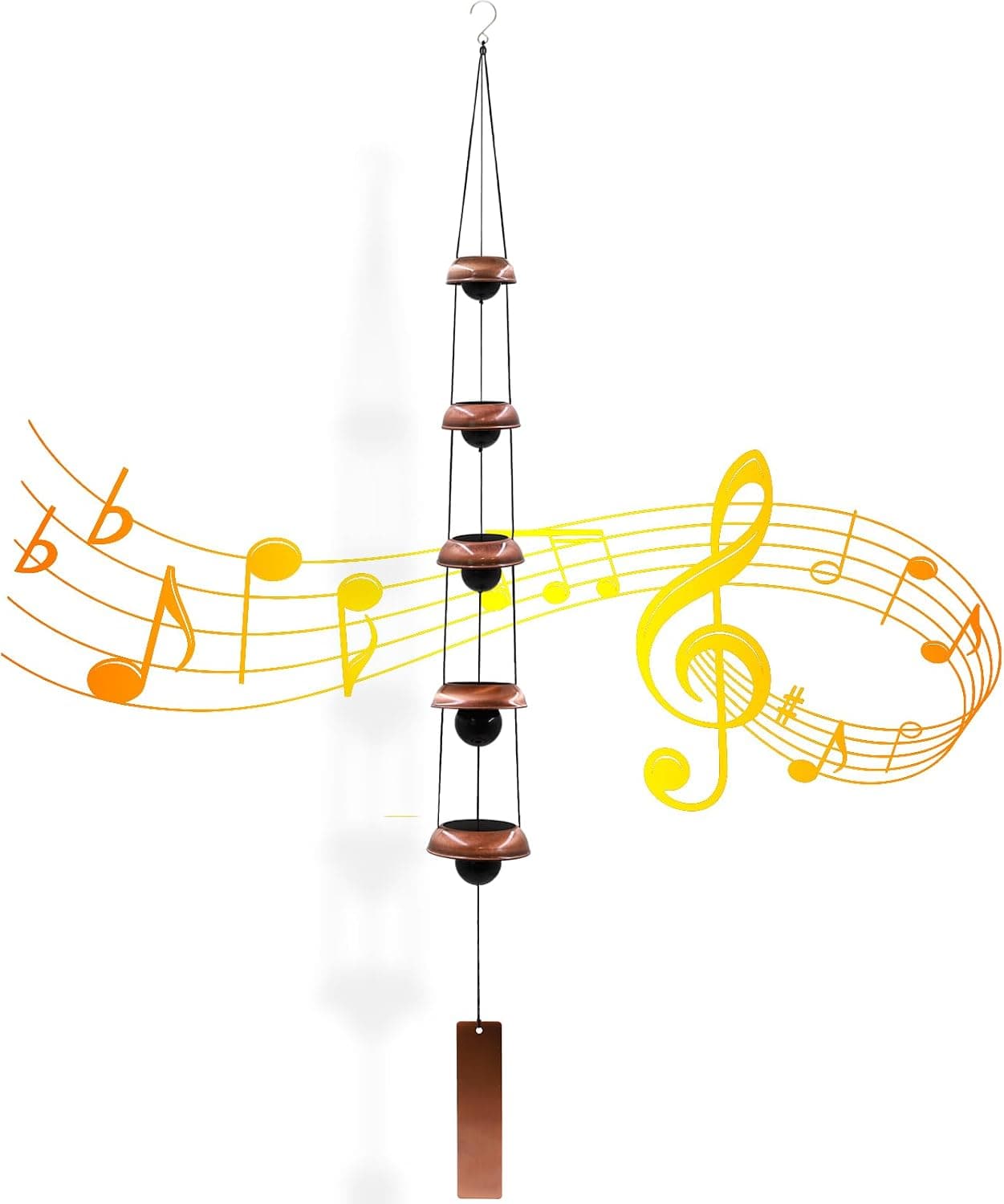
Wind Chimes for Outside with 5 Bell Unique Copper Musical Chimes Feng Shui Wi...
 -5%
YU FENG Evil Eye Money Tree, Blue Feng Shui Decor with Golden Buddha
 -29%
Karma and Luck March Birthstone Crystal Tree of Life, Aquamarine Gemstone Fen...
 -29%
Karma and Luck July Birthstone Crystal Tree of Life, Ruby Gemstone Feng Shui ...
As an Amazon Associate, we earn from qualifying purchases. We only recommend items our practitioners have personally tested.
Continue Your Journey
Explore these related guides to deepen your understanding:


Ready for Deeper Guidance?
Try our free I Ching reading for personalized wisdom, or explore our curated Feng Shui essentials.